
ASU 2025-04: Share-Based Consideration Payable to a Customer

Key Takeaways
- ASU 2025–04 clarifies accounting for share-based consideration payable to customers, reducing inconsistencies in practice.
- Customer purchase-based vesting requirements are now explicitly treated as performance conditions under ASC 718.
- Companies must estimate expected forfeitures for awards with service conditions rather than recognizing forfeitures as they occur.
- The ASC 606 variable consideration constraint does not apply to share-based consideration payable to customers.
- Organizations should begin assessing affected arrangements, controls, and reporting processes now to prepare for the 2026 effective date.
When the Financial Accounting Standards Board (FASB) issues new guidance, the implications ripple across financial reporting teams, auditors, and revenue recognition practices alike. ASU 2025–04 is no exception.
Effective for fiscal years beginning after Dec. 15, 2026, ASU 2025–04 addresses a narrow but consequential area: share-based consideration payable to customers. Specifically, it targets the intersection of ASC 606 (Revenue) and ASC 718 (Stock Compensation) – a space where inconsistent application has created meaningful diversity in practice.
The standard makes four substantive changes that finance and accounting professionals need to understand now:
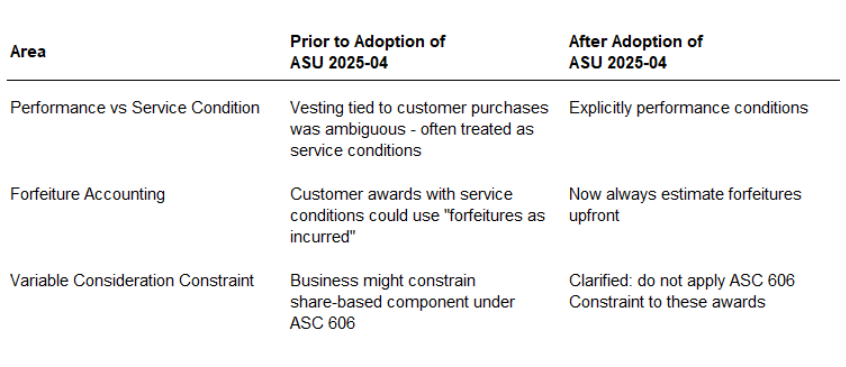
- Expanded definition of “performance condition”: Vesting tied to purchase volume, monetary thresholds, or similar customer-driven actions now explicitly qualifies as a performance condition under ASC 718.
- Elimination of the forfeiture policy election: For awards with service conditions granted to customers, companies no longer have the option to account for forfeitures as they occur. Estimation upfront is now required, aligning the transaction price reduction.
- Variable consideration constraint does not apply: ASU 2025–04 confirms that ASC 606’s variable consideration constraint guidance does not apply to share-based consideration payable to a customer.
- Vesting probability assessed under ASC 718 only: Companies use ASC 718’s “probable” threshold – defined as “likely to occur” and evaluated through professional judgment based on facts and circumstances – not the ASC 606 model.
The practical question is: what does this mean for your reporting processes, and is your organization positioned to implement these changes before the effective date?
Key Points
What ASU 2025–04 Changes & Why It Matters
ASU 2025-04 addresses diversity in practice related to vesting conditions based on customer purchases, clarifying whether they should be treated as performance or service conditions. Because this distinction can significantly impact the timing of revenue recognition, the amendment aligns ASC 718 more closely with ASC 606 by eliminating the forfeiture election and broadening the definition of a performance condition.
As a result, revenue reductions associated with share-based payment awards more accurately reflect the probability of vesting and the consideration ultimately expected to be received.
Financial Reporting & Accounting Impacts of ASU 2025-04
Management teams that issue share-based payment awards to customers need to evaluate how ASU 2025–04 affects their accounting conclusions, revenue recognition, and key financial reporting metrics.
- Revenue Recognition: ASU 2025–04 aligns the accounting for customer share-based consideration more closely with expected vesting condition achievement and consideration ultimately earned. As a result, entities may need to reassess the timing and pattern of revenue reductions recognized under these arrangements.
- Forfeiture Estimates: Awards that retain service conditions will require entities to estimate expected forfeitures and update those estimates throughout the award period. This creates a need for new estimation methodologies, supporting documentation, and ongoing monitoring processes.
- Financial Reporting Metrics: Changes in the classification of vesting conditions can affect earnings-per-share calculations and other key financial reporting measures. Management should evaluate whether existing reporting processes capture these impacts accurately.
- Presentation and Disclosure: Entities should assess whether changes in accounting conclusions under the new guidance require updates to financial statement disclosures, accounting policy descriptions, or related reporting documentation.
Implementation Steps: What Organizations Need to Do Now
Preparing for ASU 2025–04 requires a clear-eyed assessment of the operational and process changes ahead. Organizations that start early will be better positioned to adopt the new guidance without disruption.
Key implementation activities include:
- Inventory all share-based payment arrangements with customers. A complete, accurate inventory is the foundation for everything that follows.
- Reassess vesting conditions under the amended definition of a performance condition to determine where existing classifications may need to change.
- Develop or strengthen forfeiture estimation processes for awards that include service conditions, a requirement that may demand new tools or workflows.
- Update accounting policies, internal controls, and supporting documentation to reflect the revised guidance and satisfy assurance requirements.
- Evaluate transition requirements and select the applicable transition method that aligns with the organization’s reporting objectives and resource capacity.
- Assess the impact on financial statements, disclosures, and earnings-per-share calculations to surface any material effects before adoption.
The breadth of these activities makes early planning essential. Organizations that treat implementation as a compliance checklist risk underestimating the downstream effects on reporting and internal processes.
Key Dates & Transition Options
Planning ahead is critical. Here is what organizations need to know about the timeline.
- Effective Date: Applies to fiscal years beginning after Dec. 15, 2026, including interim periods. Notably, the effective date is the same for both public business entities and nonpublic entities.
- Early Adoption: Permitted for organizations that want to get ahead of the transition.
- Transition Methods: Organizations can choose between two approaches:
- Modified Retrospective: Record a cumulative-effect adjustment to opening retained earnings at the time of adoption.
- Retrospective: Recast comparative periods, with a cumulative-effect adjustment to opening retained earnings of the earliest period presented.
The choice of transition method carries real reporting implications. Organizations should assess both options carefully against their financial reporting objectives and operational capacity well before the effective date arrives.
How Wolf & Company Can Support Your ASU 2025–04 Transition
While ASU 2025–04 is narrow in scope, its impact on accounting processes and financial reporting may be broader than expected. Organizations should take a proactive approach to assessing existing arrangements, estimation processes, and reporting considerations ahead of adoption.
Wolf & Company’s assurance professionals bring deep technical expertise needed to evaluate the impact of the new guidance and prepare for a smooth transition. With the 2026 effective date approaching, now is the time to begin your assessment.
Contact our team to discuss the potential impact of ASU 2025-04 and the considerations for implementation within your organization